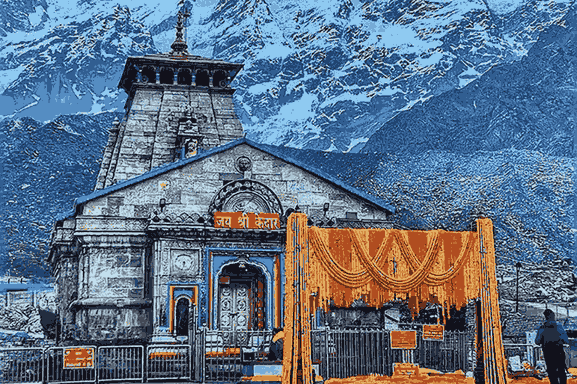
At Gaurikund, early morning around 5 AM, pilgrims gather in the cold, sip hot chai, and begin the trek with quiet chants of “Har Har Mahadev.” Soon after, from here onward, the journey truly begins, leading towards Kedarnath Temple—one of the most sacred pilgrimages in Uttarakhand.
In terms of distance, the trek is 16 km (one way) and usually takes 6–8 hours, depending on fitness and weather. However, more than just distance, it’s a step-by-step experience of devotion, endurance, and the beauty of the Himalayas. Along the way, every turn of the trail gradually adds to the spiritual and natural richness of the journey, making it not just a trek, but a meaningful experience.
First — What is Gaurikund and Why Does It Matter?
The starting point for the Kedarnath trek is Gaurikund — a small pilgrim town at 1,982 metres in the Rudraprayag district. To begin with, Gaurikund sets the tone for the entire journey ahead.
Importantly, Gaurikund is the last point accessible by vehicle before Kedarnath. Once you step off the bus or out of the taxi here, the rest of the journey is yours — on foot, on a pony, or in a palanquin. From this point onward, there are no more roads.
However, Gaurikund is not just a logistics checkpoint; rather, it holds its own spiritual significance.
In fact, Gaurikund is believed to be the very spot where Goddess Parvati performed penance to win the love of Lord Shiva. Therefore, it serves as the starting point for the trek to Kedarnath, setting the stage for a deeply sacred journey.
Moreover, the Kund (sacred pond) at Gaurikund has naturally warm water — fed by hot springs that are considered holy. Because of this, most pilgrims take a ritual dip here before beginning the trek, washing away the journey from the plains and entering the mountain space with a clean beginning.
Even if you do not take the dip, it is still worth spending a few quiet minutes at the kund before you start walking. After all, the transition from the ordinary world to the mountain world deserves a moment of acknowledgement.
The Distance — The Honest Numbers
The distance from Gaurikund to Kedarnath is around 16 kilometres. Earlier, it was a 14 km trek; however, following the 2013 flood, the authorities created a new path, and as a result, it is now 16 km.
In reality, the trek often feels longer than the number suggests. This is because the altitude gain, unpredictable mountain weather, and crowd movement during peak yatra season make it physically demanding. Even so, for many pilgrims, this climb is not just a journey — rather, it becomes a part of the spiritual test.
To understand it better, here is the honest breakdown:
| Segment | Distance | Time (approx.) |
|---|---|---|
| Gaurikund to Jungle Chatti | 4 km | 1.5 to 2 hours |
| Jungle Chatti to Bheembali | 3 km | 1 to 1.5 hours |
| Bheembali to Lincholi | 4 km | 1.5 to 2 hours |
| Lincholi to Base Camp | 3 km | 1 to 1.5 hours |
| Base Camp to Kedarnath Temple | 2 km | 30 to 45 minutes |
| Total | 16 km | 6 to 10 hours |
Gaurikund to Kedarnath — Simple Trek Guide
Starting Point — Gaurikund
- Registration for Kedarnath Yatra is mandatory
- Start early between 4:30–6:00 AM; last entry is at 1:30 PM
- Pony or palki bookings are available if required
Gaurikund → Jungle Chatti (4 km | 1.5–2 hrs)
An easy, forested trail begins the trek, making it ideal to settle into a comfortable pace, with tea stalls available along the way.
Jungle Chatti → Bheembali (3 km | 1–1.5 hrs)
The path becomes slightly steeper; however, it rewards you with better views. This is also a good place to rest, with food, water, and basic facilities available.
Bheembali → Lincholi (4 km | 1.5–2 hrs)
A steeper climb follows, where altitude starts to have an effect. Walking slowly and staying hydrated is essential, while medical aid and tents are available if needed.
Lincholi → Base Camp (3 km | 1–1.5 hrs)
The terrain opens up with no tree cover, and the air gets thinner. Moving step by step and focusing on breathing helps maintain energy.
Base Camp → Kedarnath Temple (1–2 km | 30–45 min)
The final stretch is almost flat, and as the temple comes into view, it brings an emotional moment—one worth pausing for before moving ahead.
How Long Does the Trek Actually Take?
The trek from Gaurikund to Kedarnath Temple depends on fitness and travel mode.
Time by Pilgrim Type
| Pilgrim Type | Expected Time |
|---|---|
| Fit young adults | 5.5 – 7 hours |
| Average fitness (first-timers) | 7 – 9 hours |
| Families with children | 8 – 10 hours |
| Senior citizens (on foot) | 9 – 12 hours |
| Pony / Palki | 5 – 7 hours |
| Helicopter (Phata to Kedarnath) | 5 – 7 minutes |
What You Will See Along the Way
The trek to Kedarnath Temple is not just a pilgrimage—it’s one of the most visually stunning journeys in Uttarakhand.
- Mandakini River — A fast-flowing, turquoise river that stays with you through much of the lower trek. Crossing bridges over it, with the sound of rushing water below, is both calming and energising.
- Bhimshila Rock — A massive sacred rock believed to have protected the temple during the 2013 Kedarnath floods, adding deep spiritual significance to the site.
- Kedarnath Peak & Glacier — As you approach the base camp, the towering snow-covered peak (6,940 m) and its glacier gradually dominate the landscape, thereby creating a breathtaking, almost unreal view.
- The Temple — Finally, the ancient stone structure of Kedarnath, one of the twelve Jyotirlingas of Lord Shiva, stands at 11,755 feet. Here, the evening aarti, with fire lamps against the Himalayan backdrop, becomes a truly unforgettable spiritual experience.
A journey where every step offers something powerful—both visually and spiritually.
The Trek Timings — Critical Rules to Follow
The trek to Kedarnath Temple follows strict timing rules for safety. Firstly, pilgrims must begin from Gaurikund between 4:00 AM and 1:30 PM, with 1:30 PM being the final cutoff—after which no entry is allowed. Similarly, for the return journey, pilgrims must start descending from Kedarnath before 5:00 PM. However, these timings may change depending on weather and safety conditions.
In practical terms, starting late reduces daylight and therefore increases risk on this long, high-altitude trek.
So, the simple rule is:
Start before 6:00 AM for a comfortable pace. On the other hand, avoid starting after 10:00 AM, as otherwise, it becomes difficult to complete the trek safely in daylight.
Altitude and Health — What You Must Know
Kedarnath Temple sits at 11,755 feet; therefore, the steep climb from Gaurikund can cause altitude sickness. As a result, breathlessness, nausea, and fatigue are common after Lincholi. Hence, walk slowly, take breaks, stay hydrated, and additionally, acclimatize at Sonprayag or Guptkashi.
Watch for headache, dizziness, fatigue, or breathing difficulty. If symptoms appear, rest; otherwise, descend immediately.
Extra caution: seniors, young children, and those with heart issues, BP, asthma, or diabetes should consult a doctor beforehand.
Essential Packing List
Pack layers to handle cold mornings (5 to 10°C), sunny days, and sudden rain at 3,583 metres altitude:
Clothing:
- Thermal innerwear — top and bottom
- 2 to 3 quick-dry full-sleeve tops or fleece layers
- Windproof and waterproof jacket or poncho
- Trekking pants — 2 pairs, stretchable
- Woolen cap and insulated gloves
- Woollen socks — 2 to 3 pairs
- Sturdy trekking shoes with ankle support
Common Mistakes to Avoid
Most first-timers start their Kedarnath trek after 8 to 9 AM, thinking they will have enough time. That is risky. The temple closes by 3 PM, and fog or rain hits after noon. Mules and Palki bookings also stop early.
Mistake 1: Starting late. Start before 6 AM. Non-negotiable.
Mistake 2: Going too fast in the first half. The first section feels easy. Use that ease to conserve energy for the steep section above Lincholi.
Mistake 3: Not drinking enough water. Drink water steadily — 3 to 4 litres through the day. Do not wait until you are thirsty at altitude.
Mistake 4: Not registering. You cannot enter beyond Sonprayag without UTDB registration. Register online before you travel.
Mistake 5: No physical preparation. Two weeks of daily walking makes a noticeable difference. Not marathon training — just 45 minutes of walking or stairs every day in the lead-up.
Mistake 6: Skipping acclimatization. Many first-timers land from Delhi and start the trek the next morning. Your body needs time to adjust to altitude. Spend a night in Sonprayag or Guptkashi.
Best Time to Do the Trek
The best time to visit Kedarnath is May to October, when weather conditions are suitable. The monsoon season (July to August) brings heavy rains and landslides, making the trek risky.
| Season | Conditions | Recommendation |
|---|---|---|
| May to June | Temple newly opened, rhododendrons blooming, peak crowds | Popular, beautiful |
| July to August | Heavy rains, slippery trails, landslide risk | Only for flexible, experienced trekkers |
| September to October | Post-monsoon clarity, fewer crowds, perfect views | Best overall — highly recommended |
| November | Temple closes (check exact date each year) | End of season |
| December to April | Temple closed, route inaccessible | Closed |
How to Reach Gaurikund
The nearest railway station to Kedarnath is in Rishikesh, which is about 216 km away from the temple. To begin with, you can take a train from Delhi to Rishikesh and then hire a taxi to reach Gaurikund. From there, you need to trek for about 16 km to finally reach the temple.
In terms of travel time, the journey takes approximately 8 to 10 hours from Haridwar and comparatively 6 to 8 hours from Rishikesh. However, the duration may vary depending on road conditions, traffic, and weather.
Route from Delhi:
Delhi → Haridwar/Rishikesh (by train or bus, overnight) → Srinagar → Rudraprayag → Agastyamuni → Guptkashi → Sonprayag → Gaurikund
From Sonprayag, shared jeeps and taxis run to Gaurikund (5 km). However, private vehicles are not permitted beyond Sonprayag.
Save these emergency numbers in your phone before the trek:
- Uttarakhand Disaster Helpline: 1077
- SDRF Emergency: 112
Conclusion — 16 Kilometres That Change You
Kedarnath Temple is not just a destination—it’s an experience that transforms you, especially across the 16-kilometre trek from Gaurikund. In fact, most travel guides rarely highlight how different the return journey feels. While the ascent is filled with anticipation—focused on effort and reaching the temple—in contrast, the descent turns reflective. As a result, walking back through Lincholi and Bheembali, with the valley opening ahead, brings a quiet sense of completion.
Moreover, this moderately difficult trek passes through valleys, rocky paths, waterfalls, and alongside the Mandakini River. More importantly, beyond the physical challenge, it becomes a journey of endurance and devotion. At first glance, 16 kilometres may seem simple; however, in reality, it marks a deeper spiritual transition.
For centuries, pilgrims have walked this path with chants of “Har Har Mahadev.” Therefore, to truly experience it, prepare well, start early, and walk steadily. Above all, pause when the temple first appears—because ultimately, that moment stays with you long after the journey ends.
Har Har Mahadev.
