Where is the Adi Kailash Mountain Located?
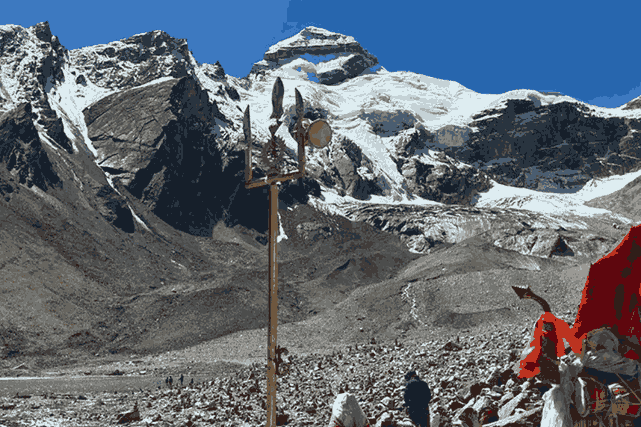
Adi Kailash is located in the remote Pithoragarh district of Uttarakhand, India. It is one of the most sacred and least-visited peaks in the Himalayas. The mountain stands at a height of around 6,191 metres (20,312 feet). Adi Kailash lies near the border of Tibet and Nepal. This location makes it spiritually important for thousands of years. People also call it Chhota Kailash or Baba Kailash, which shows its strong connection with the Kailash tradition.
The nearest base village is Jolingkong, and the trek passes through the breathtaking Darma and Johar valleys, hugging the banks of the Kali River. The landscape is staggering — dense pine forests give way to alpine meadows, and then to high-altitude glacial terrain dusted in perpetual snow. Unlike Mount Kailash in Tibet, which requires a separate visa and lengthy international arrangements, Adi Kailash falls entirely within Indian borders, making it accessible to Indian pilgrims without crossing international boundaries.
What is the History of Kailash Parvat?
The history of Kailash Parvat in both Tibet and India goes back thousands of years. Hindu texts like the Vedas, Upanishads, Puranas, Ramayana, and Mahabharata describe Kailash as a sacred place. These texts place it at the centre of spiritual belief. The Puranas also describe it as Sumeru or Meru, the cosmic mountain around which the universe revolves.
Written records of the Kailash pilgrimage appear around the 7th–8th century CE. However, people followed this tradition much earlier through oral beliefs. Adi Shankaracharya played an important role in reviving the Char Dham Yatra in the 8th century. By that time, the Kailash Mansarovar Yatra had already become an important pilgrimage.
The history of Adi Kailash is closely connected with the Kumaon Kingdom and the Katyuri dynasty. These rulers governed the region between the 7th and 11th centuries CE. They supported temples and sacred travel routes in the Himalayas. Later, British surveys in the 19th century brought Adi Kailash into administrative records. However, local people already knew about its sacred importance for generations.
In modern times, the Kumaon Mandal Vikas Nigam (KMVN) and the Indian government have developed infrastructure to make the Adi Kailash Yatra safer and more accessible, particularly after the route became a government-recognised pilgrimage. Yet despite these developments, the journey retains its raw, elemental character — a reminder that some pilgrimages are not about comfort, but about transformation.
About Adi Kailash Yatra — Mangal Mythology
The Adi Kailash Yatra is not merely a trek — it is a deeply layered mythological journey. According to the Skanda Purana and several regional oral traditions, Adi Kailash is mentioned as Shiva Parvata, the mountain where Lord Shiva performed his first great tapas (penance) after descending from his formless cosmic state into the physical world.
One of the most enduring mythological narratives tied to this region involves the Pandavas. It is believed that the five Pandava brothers, during their final journey to heaven (the Mahaprasthana), passed through this very terrain. The Jolingkong Valley, they say, resonates with the memory of that great departure — which is why the surrounding landscape feels less like a mountain trek and more like a passage through sacred time.
The Om Parvat, located nearby, adds another layer of mythology and wonder. This peak, also called Adidailash Shikhar, bears a natural snow formation on its face shaped unmistakably like the Sanskrit symbol “ॐ” (Om). For Hindus, Om is the primordial sound — the vibration from which the entire universe emerged. The fact that nature itself has inscribed this symbol on a mountain is considered nothing short of a divine signature. Pilgrims often weep upon first seeing it, overwhelmed by the feeling that they are standing in the presence of something ancient and eternal.
BEST TIME TO VISIT ADI KAILASH OM PARVAT (SEASON-WISE)
Timing your visit carefully is essential, as the mountain terrain around Adi Kailash is notoriously unforgiving in the wrong season. Here is a season-by-season breakdown:
MAY TO JUNE — PRIME SEASON (HIGHLY RECOMMENDED)
This is the best time for the Adi Kailash Yatra. Snow starts melting and high-altitude routes open after winter. The weather remains clear and stable. Day temperature ranges between 5°C and 15°C.
During this time, the Om Parvat snow symbol looks very clear and beautiful. Green meadows, flowing rivers, and fresh mountain air make the journey even more enjoyable. KMVN also organizes official yatra groups in this season.
JULY TO AUGUST — MONSOON SEASON (AVOID)
This is not a good time to visit Adi Kailash. Heavy rainfall increases the risk of landslides and road blockages. Trekking routes become slippery and unsafe.
Due to safety reasons, the government usually stops the yatra during this period. Clouds also block the view of Om Parvat.
SEPTEMBER TO OCTOBER — AUTUMN WINDOW (RECOMMENDED)
After the monsoon ends, this season offers clear skies and beautiful mountain views. The weather becomes fresh and pleasant, making it ideal for trekking.
The Om Parvat symbol becomes visible again. However, nights can be very cold, so warm clothes are necessary. This season is less crowded, which gives a peaceful experience.
NOVEMBER TO APRIL — WINTER CLOSURE
The mountain passes are completely snow-bound, the roads inaccessible, and the entire Yatra route effectively closed. The region experiences extreme cold, with temperatures plummeting to -20°C or lower at altitude. No official yatra is conducted during these months.
BEST ATTRACTIONS OF ADI KAILASH AND OM PARVAT YATRA
The Adi Kailash Om Parvat Yatra is not a journey of a single destination — it is a pilgrimage of accumulating wonders. Here are the must-see highlights along the route:
OM PARVAT AND NABHI DANG VIEWPOINT
Om Parvat is the most famous attraction of this yatra. From Nabhi Dang, you get a clear view of the mountain where snow forms a natural ॐ symbol. Many pilgrims feel emotional after seeing this view.
Reaching the viewpoint requires an uphill walk, but the experience is unforgettable.
PARVATI TAL (LAKE)
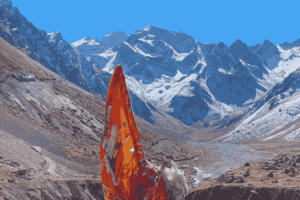
Parvati Tal is a beautiful glacial lake near Jolingkong base camp. Many people believe that Goddess Parvati bathed here during her penance.
The lake reflects the surrounding mountains and creates a peaceful atmosphere. Pilgrims also perform rituals and prayers at this place.
NARAYAN ASHRAM
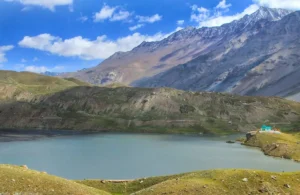
Narayan Ashram is located on the way to Adi Kailash. It was established in 1936 and provides food, shelter, and a peaceful environment for pilgrims.
Many travelers stop here to rest and prepare for the journey ahead.

GUNJI VILLAGE
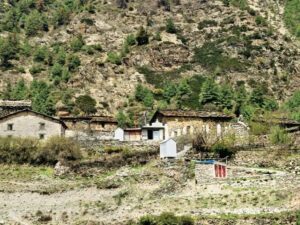
Gunji village is an important stop for rest and acclimatization. It is home to the Bhotia community.
Basic food and accommodation are available here. This village also connects routes to Adi Kailash and Lipulekh Pass.
Where Does Lord Shiva Live? Adi Kailash vs Mount Kailash?
This question creates debate among devotees, scholars, and sadhus. The answer is deep but not simple.
In Hindu tradition, Lord Shiva’s main abode is Mount Kailash. It is a 6,638-metre high peak in Tibet. According to the Puranas, Shiva meditates here with Goddess Parvati. Many people also consider it the center of the universe.
However, Adi Kailash also has special importance. The word “Adi” means original or first. Many devotees believe that Adi Kailash was Shiva’s first home in the Himalayas.
Some ancient texts suggest that Shiva chose this peaceful place in the Kumaon region. It offered a quieter space compared to Mount Kailash.
“Both peaks are Shiva’s home. One represents his cosmic presence. The other feels closer to devotees on Earth.”
Many pilgrims cannot travel to Mount Kailash due to international restrictions. So, they choose Adi Kailash as an alternative.
The belief is simple. Shiva is present everywhere. Both mountains represent the same divine power.
Is it True that Adi Kailash was the Oldest Abode of Lord Shiva?
Many Shaivite scholars and Himalayan priests firmly believe so. The word “Adi” — meaning first or original — is not used casually in Sanskrit. When applied to Kailash, it makes a pointed theological claim: this was the original Kailash, predating even the Tibetan peak in Shiva’s story on Earth.
Ancient texts like the Kedar Khand section of the Skanda Purana describe this mountain region as the original seat of Shiva’s manifest presence in the Himalayas. The argument goes that as Shiva’s worship spread northward through the ages, Mount Kailash in Tibet became the dominant narrative — but the roots of that tradition lay here, in the Kumaon hills, closer to the Indian heartland of devotion.
Archaeologically and anthropologically, the Johar Valley has evidence of human habitation and religious activity going back thousands of years. The Bhotia communities who have lived in these high valleys for generations carry forward oral traditions that treat Adi Kailash not as a “lesser Kailash” but as the original source — the parent, not the copy. For many devotees, completing the Adi Kailash Yatra feels like returning to the very beginning of something sacred.
Mysterious Miracles at Kailash Parvat and Mansarovar Lake
Whether you are a firm believer or a curious sceptic, the reported phenomena around both Kailash peaks and the associated Mansarovar Lake are genuinely fascinating. Pilgrims and mountaineers alike have described experiences that resist easy explanation — and it would be dishonest to simply dismiss them.
Near Adi Kailash’s Parvati Tal (the small lake at the base, considered a counterpart to Mansarovar), many pilgrims report a deep, inexplicable sense of stillness — a feeling of time slowing down or becoming irrelevant. Some describe hearing faint chanting or bell-like sounds in the wind that cannot be attributed to any known source. Others report vivid, unusually clear dreams after spending a night near the lake’s shore.
At the original Mount Kailash and Lake Mansarovar in Tibet, the phenomena reported are even more widely documented. Scientists have noted that the mountain’s near-perfect pyramidal form — four distinct faces aligned with the cardinal directions — is unusual for a naturally formed peak. Some researchers have pointed to the area as having uniquely powerful geomagnetic properties. Pilgrims frequently report that compasses behave erratically near the mountain.
Why book with Nagarjuna
Planning a journey like the Adi Kailash and Om Parvat Yatra is not just about reaching a destination — it’s about navigating one of the most remote and sensitive regions of the Indian Himalayas. From inner line permits and medical checks to road conditions and altitude challenges, the logistics can quickly become overwhelming if you’re doing it on your own.
This is where travelling with an experienced operator offering an Adi Kailash and Om Parvat package like Nagarjuna Travels can make a real difference.With a deep understanding of the Kumaon region, well-planned itineraries, and on-ground support, they help simplify what is otherwise a complex journey. Their structured approach ensures that permits, accommodation, meals, and transportation are taken care of, allowing you to focus on the spiritual and experiential side of the yatra.
Another important aspect is safety and acclimatisation. Reliable tour operators ensure gradual altitude gain, proper rest stops at places like Gunji and Kalapani, and access to basic medical support — all of which are crucial in high-altitude travel.
For many pilgrims, especially those travelling with family or for the first time, choosing a trusted organiser brings peace of mind. Instead of worrying about arrangements, you can fully immerse yourself in the sacred experience of Adi Kailash and the powerful दर्शन of Om Parvat.
If you’re looking for a smoother, well-supported journey, exploring the yatra with Nagarjuna can be a practical and reassuring choice.
Conclusion
The Adi Kailash Om Parvat Yatra is not for the faint-hearted — it demands physical preparation, mental resilience, and a willingness to be uncomfortable in the most beautiful way imaginable. But it rewards those who make the effort with something that very few journeys can offer: the genuine, felt sense of having touched something ancient and sacred and real.
Whether you make the journey as a devout pilgrimage, an adventure trek, or a philosophical inquiry into the nature of sacred geography, you will return changed. The mountains do not grant their secrets cheaply — but they do grant them, to those who come with open eyes and a sincere heart.
Har Har Mahadev.
